When Joe Cruz, Senior Mechanical Engineer/Associate and healthcare specialist at Integrated Design Solutions (IDS) in Troy, Michigan, began working on a new psychiatric healthcare facility in Northville, Michigan, he knew he had a challenge ahead of him: ensuring every patient room could receive hot water quickly and consistently throughout an expansive domestic hot water recirculation system.
Cruz has encountered domestic hot water return issues on previous healthcare projects. “It is very common to wait for long periods of time before receiving hot water at sinks and showers in various facilities, even when they had traditional recirculation systems,” he recalled. Those experiences led him to question the traditional approach to balancing domestic hot water recirculation systems.
Most systems rely on manual balancing valves that require careful flow calculations and field adjustments. “Many engineering drawings I’ve seen show the balancing valve set at 0.5 GPM for every single return location,” Cruz said. “That is a tell-tale sign of lazy engineering. You must calculate the flow based on the piping run, pipe size, and the desired return temperature. Nobody ever seems to do it right and one-time balancing does not necessarily facilitate future renovations and expansions, so we started looking for a better way.”
Discovering Thermostatic Balancing
Cruz first specified CircuitSolver in 2015 while designing a healthcare facility in North Ridgeville, Ohio. After evaluating several options, his team selected CircuitSolver because its stainless steel construction offered long-term durability while its thermostatic operation eliminated manual balancing. Approximately 15 to 20 CircuitSolver valves were installed for that project.
“The solution was simple and we never received a call about hot water issues on that building,” Cruz recalled. “Manual systems required significant time to commission and often needed readjustment over time. If owners need to rebalance their domestic hot water return system every time they modify their building, it’s not simple anymore, right?” Cruz said. “We were looking for a more reliable and predictable approach.”
Based on that experience, Cruz continued specifying CircuitSolver on healthcare projects.
The New Opportunity
Cruz’s latest project was the new Southeast Michigan Psychiatric Hospital in Northville Township, Michigan, scheduled to open in October 2026. The facility consolidates two existing psychiatric hospitals into a 231-bed campus with separate adult and pediatric treatment areas. Its domestic hot water system serves 268 recirculation zones throughout the facility.
The facility includes four two-story adult wings and three single-story pediatric wings and approximately 180,000 square-feet of facilities, administrative and common spaces. To serve all 268 recirculation zones, 268 CircuitSolver valves were installed, one on each hot water return branch within 25 linear feet of the last fixture as recommended by The Facility Guidelines Institute (FGI).
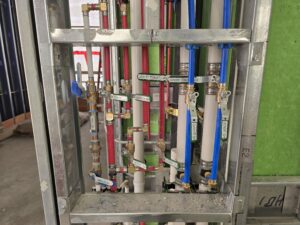
To accelerate construction, the project incorporated 231 prefabricated patient-room bathroom pods to streamline installation and improve cost control. Each patient bathroom includes an access panel located in the corridor wall, where individual fixture isolation valves are installed, allowing staff to quickly stop water flow in the event of an emergency. CircuitSolver valves were incorporated into the access panels for each patient restroom which place them 18-24 linear feet of the furthest hot water consuming fixture.
The Result
During system startup, the design team verified hot water delivery at the facility’s most remote fixtures.
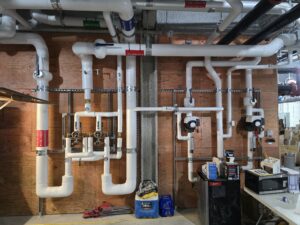
“We have instantaneous domestic hot water heat exchangers being served by a dedicated dual-fuel boiler system” Cruz explained. “The furthest shower is approximately 1,115 feet from the domestic hot water heat exchangers, and we observed hot water within ten seconds in a system with little to no use (during construction). When we tested the furthest manually operated sink from the central utility plant, located about 1,005 feet away, we observed hot water in approximately eight seconds.”
Cruz said the installation and commissioning process was straightforward with CircuitSolver thermostatic balancing valves. “CircuitSolver saved a lot of time typically spent on balancing. There were no balancing calculations required for each circuit and no rebalancing required after startup.” The only balancing required is dialing in the hot water recirculation pump speed to maintain the desired return water temperature.
Standardizing the Approach
Based on consistent performance across multiple healthcare projects, Cruz has incorporated CircuitSolver thermostatic balancing valves into Integrated Design Solutions’ standard plumbing details.
“Priorities are shifting in plumbing design,” Cruz said. “Cost is always a huge consideration, along with energy savings.” In healthcare facilities, however, Cruz believes patient safety and system reliability remain the primary drivers of domestic hot water system design.
“If a project uses our standard detail, it will include a specification for CircuitSolver,” Cruz said.
After specifying and installing CircuitSolver for over 10 years, Cruz remains confident in the technology. “CircuitSolver has been the best balancing option when it comes to healthcare,” he said. “My experience with CircuitSolver has simplified my designs and has proven to be reliable. CircuitSolver is the number one method of domestic hot water circulation I would recommend to a client or engineer.”
Photo Credits: The equipment pictures were taken by Joe Cruz, PE, and the drone photos were taken by Dean Barr, Field Representative for the State of Michigan Department of Technology, Management and Budget (DTMB).
Hot water distribution systems are critical to plumbing design, especially in large residential and commercial buildings. Maintaining consistent hot water temperatures across these systems can be challenging, but thermostatic balancing valves have emerged as an innovative solution.
What Are Thermostatic Balancing Valves?
A thermostatic balancing valve is a dynamic device that automatically adjusts water flow in response to temperature changes within a domestic hot water system (DHWS). Unlike manual balancing valves, which maintain a set position, thermostatic valves continuously adapt to real-time conditions, optimizing water flow without manual intervention. These valves rely solely on sensing temperature to maintain a set temperature in the water lines instead of using pressure or flow calculations. It is a temperature device solving a temperature problem.
By ensuring hot water is distributed evenly throughout the system, thermostatic balancing valves improve energy efficiency, minimize water waste, reduce maintenance needs, and provide hot water on demand.
Why is Balancing a DHWS Necessary?
In any hot water recirculation system, water naturally flows through the path of least resistance. This often leads to uneven distribution, where branches or risers located farther from the hot water source experience reduced flow and significant heat loss.
Balancing valves counteract these issues by normalizing water flow throughout the system. Installed at the end of the branch or the top of each riser, these valves ensure sufficient flow and temperature in every branch or riser to offset the heat loss.
Typically, the branches/risers closest to the water source require the least flow, and the ones further away require more.
Types of Balancing Valves Used Today
Several balancing valves are available today, each with its advantages and disadvantages.
Manual Balancing Valves
Manual balancing valves have traditionally been used in DHWS. They are an adjustable ball valve type with pressure ports used to determine the flow. While functional and inexpensive, they require iterative adjustment to balance DHWS because they are pressure-dependent flow devices. Every time a manual balancing valve is adjusted, it impacts the setting of all the other valves in the system. This process can be time-consuming and expensive, especially in larger systems, and often requires a journeyman or certified plumber to balance the system.
Fixed Flow Balancing Valves
Also known as pressure-independent or automatic balancing valves, these devices have a constant flow rate based on a customer-selected cartridge. They utilize replaceable, flow-regulating cartridges, each with a set operating flow rate and differential pressure ranges, eliminating labor associated with manual balancing. Fixed flow valves have static flow settings and are not dynamic, meaning they do not adjust the flow as conditions change within a system.
Due to their small orifices and tight clearances, they are also prone to clogging in high mineral-content environments.
Electric Balancing Valves
Electric valves offer temperature sensing, motorized control, and integration with a building management system (BMS). While they provide advanced control and data monitoring, these valves are complex, expensive, and less reliable due to their intricate components. The use of these valves in DHWS has been minimal.
Thermostatic Balancing Valves
Thermostatic valves dynamically adjust flow based on real-time temperature changes. By sensing the water temperature, they automatically modulate flow to maintain a set temperature in the branch or riser, eliminating the need for manual calculations and adjustments. This technology ensures quick and accurate system balancing.
How Thermal Balancing Valves Operate
Thermostatic balancing valves are gaining attention due to their ability to automatically regulate water temperatures in domestic hot water systems – eliminating manual balancing and callbacks.
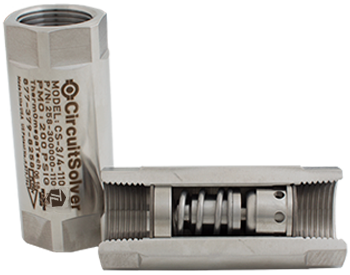
Thermal balancing valves use paraffin wax actuators to modulate flow based on fluid temperature. A temperature increase changes the wax state from solid to liquid, creating a maximum change in volume. The wax pushes on the diaphragm and extends a piston to adjust the amount of flow through the valve. As the temperature cools, the wax returns to a solid, and the piston retracts, allowing for more flow. This simple, reliable mechanism enables precise temperature control.
Key Advantages Include:
No manual intervention: The valves adjust automatically as system conditions change.
Energy efficiency: Consistent temperature control reduces heat loss and water waste.
Reliable operation: The wax-based actuator has no shelf life and ensures long-term durability.
Pump protection: Valves never fully close, ensuring adequate flow to prevent pump overheating.
Fixed vs. Adjustable Thermostatic Valves
Fixed Thermostatic Valves
Fixed thermostatic balancing valves are factory-calibrated for a specific temperature and cannot be adjusted in the field. A replacement kit can quickly change the actuator’s temperature set point, but they are set for a given return temperature. This tamper-proof design eliminates the risk of adjustment by non-qualified personnel and ensures consistent performance.
Fixed thermostatic balancing valves have a higher Cv than adjustable valves at 5°F below their set point because they go from fully extended to retracted over a 10°F lifespan vs. 50°F for the adjustable thermostatic balancing valves. With a broader stroke range and higher Cv, fixed thermostatic balancing valves minimize pressure drops and simplify installation.
Adjustable Thermostatic Valves
Adjustable thermostatic balancing valves have an actuator cartridge design that allows users to set the desired temperature by adjusting the position of the actuator. The temperature range is typically over a 50°F span. They have low Cv at 5°F below the desired return temperature, resulting in higher pressure drops than fixed valves (>4:1).
While versatile, these valves require calibration during installation, which introduces potential errors if some valves are set incorrectly in the system, making troubleshooting difficult.
For over a decade, CircuitSolver® thermostatic balancing valves have transformed domestic hot water recirculating system balancing. By automatically and continuously adjusting to maintain the specified water temperature, CircuitSolver® eliminates the labor-intensive process of manual balancing. It is a temperature device solving a temperature problem—not a flow device trying to solve a temperature problem.
Key Benefits Include:
Reliable performance: CircuitSolver® addresses temperature problems directly, ensuring even hot water distribution.
Ease of installation: Ideal for both new construction and retrofits, these valves simplify system balancing without requiring balancing.
Reduced callbacks: Automatically balancing the system resolves common hot water issues, eliminating the need to have a professional balance the system.
With thousands of successful installations, CircuitSolver® thermostatic hot water recirculation valves are a trusted solution for plumbing engineers and contractors seeking efficiency and reliability.
Ready to optimize your next plumbing project? Contact CircuitSolver® to learn more about our thermostatic balancing valves and how they can simplify your DHWS design.
Watch our webinar to learn more about thermostatic balancing valves.
Luke Paschall, owner of Aquious, a family-owned plumbing business in Reno, Nevada, faced the challenge of balancing the domestic hot water recirculation system (DHWS) at the newly constructed Canyon’s Edge Apartments.
This residential complex, consisting of two three-story buildings with a mix of one-, two-, and three-bedroom units, required a reliable and efficient solution to ensure consistent hot water delivery to all apartments.
Aquious, known for its expertise in plumbing and tankless water heater services for residential and commercial properties, is led by Paschall, a third-generation plumber. Regarding this project, Paschall turned to his long-time friend and business associate, Matt Reilly of Zurier Company in Livermore, California, for advice. Reilly recommended using CircuitSolver thermostatic balancing valves, a suggestion Paschal was eager to explore.
The Solution
Canyon’s Edge Apartment complex.
The Canyon’s Edge Apartments complex has two buildings, each housing 24 units. To achieve optimal balance in the DHWS, Paschall installed eight ½” CircuitSolver thermostatic balancing valves in each building.
The first phase of the apartment complex was completed in May 2024, and Paschall was immediately impressed by the ease of installation and the effectiveness of the valves.
Paschall remarked that the installation process was incredibly straightforward. “I turned on the hot water, waited a bit, and everything was automatically balanced. I walked away happy! I would tell [contractors] to install and walk away; no training or special equipment is needed.”
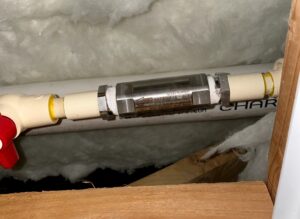
Installed CircuitSolver thermostatic valve.
Paschall noted that the CircuitSolver valves eliminated the need for manual adjustments, which had been a challenge with previous projects.
“We have used manual valves before; typically, we would set each one to 1 gpm and let it run. However, in larger systems, we do have to go back and adjust them if it seems like the flow isn’t proper or there are temperature variations,” he explained. “It is not the most scientific way of doing it. With CircuitSolver, we did not have to set flow rates – we could plug and play.”
The Outcome
Six months after the installation, the Canyon’s Edge Apartments have been fully leased, and residents have not complained about hot water availability. The system has performed flawlessly, reinforcing Paschall’s confidence in the CircuitSolver solution.
Paschall and his team at Aquious plan to continue using CircuitSolver thermostatic balancing valves in future projects, and they are confident in their ability to provide reliable, dynamic balancing. “We have bid on several multi-family and commercial properties using CircuitSolver. It has become our go-to solution for balancing hot water recirculation systems,” Paschall stated.
Have you specified or installed a CircuitSolver thermostatic balancing valve in hospitals, stadiums, restaurants, dormitories, or other facilities? If so, we could do a case study on your experiences.
Read other case studies here.
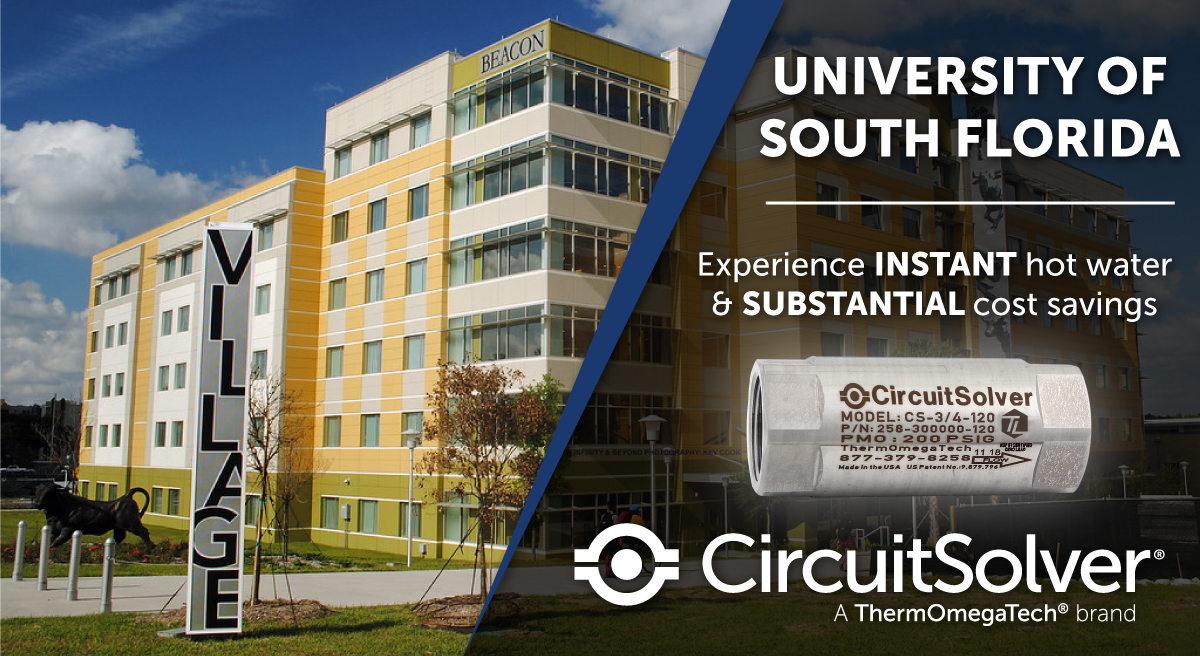
The USF is a public university with its main campus located in Tampa. About 10% of the school’s almost 40,000 undergraduate students live in one of the 44 on-campus dormitories. After temporarily shutting down during the height of the coronavirus pandemic in 2020, dorms reopened to students in the Fall of 2021.
THE OPPORTUNITY
Beacon Hall, the newest addition to the university’s on-campus dormitory buildings, opened in August of 2017. A coed, six-story construction, the dorm houses 378 residents in a mix of traditional and suite-style rooms.
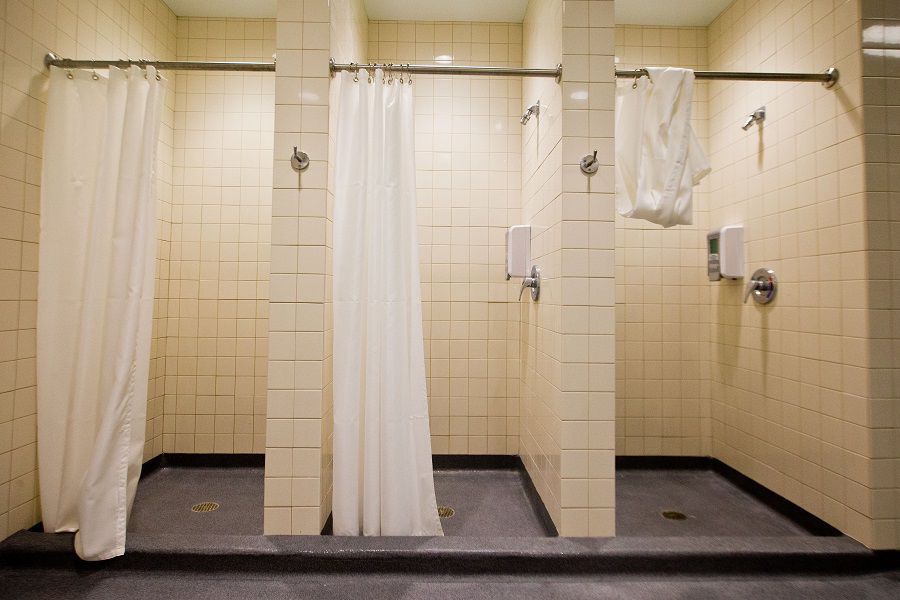
Since opening, the 5th-floor gang shower, which is located in the center of the floor with student rooms lining the exterior of the building, had experienced a lot of hot water issues.
Mike Bishop, VP of Engineering at RGD Consulting Engineers stated: “Students used to turn on the showers, go to breakfast for 30 minutes, then come back to shower when the water was hot. Otherwise, they were taking a cold shower.”
A major inconvenience to students and a huge waste of water for the university, the system’s hot water demands needed to be re-evaluated.
THE INSTALLATION
After unsuccessful attempts to rectify the hot water supply and balancing issues, the developer contacted RGD Consulting Engineers.
Mike Bishop discovered that the manual balancing valves were a major roadblock in the DHW system functioning correctly due to its inability to adapt to changing system demands, and, with no question, recommended CircuitSolver thermostatic balancing valves.
Working with Spirit Group, a CircuitSolver representative in Florida, thirteen ½” CircuitSolver valves were installed at the end of each branch and one ½” CircuitSolver was placed on the return line to the water heater.
HOW THE CIRCUITSOLVER WORKS
The CircuitSolver® is a thermostatic balancing valve that automatically and continuously adjusts flow through a DHW system to maintain a specified temperature at the end of each hot water supply line. This keeps the system fully balanced with hot water available at all times and on all floors, even with variable and intermittent demands.
On startup, the system automatically balanced itself in under 3 hours, all without manual labor. “In the meantime, the plumber actually went out a did another job,” Bishop mentions, “Then they went and got breakfast, and when they came back [the DHW system] was balanced.”
THE RESULT
Since the installation of CircuitSolvers, all balancing issues in the Beacon Hall dormitory have been resolved. Students are able to take hot showers without 30-minute wait times, and complaints have ceased. Water usage has plummeted, and the extra recirculation pump was removed, effectively reducing utility usage.
As for Mike Bishop, in this balancing case study, he says that the contractor on the job reported a favorable experience. “He was ecstatic! This was his first CircuitSolver job, but he’s going to start using it everywhere.”
Residential CircuitSolver Installation Case Study – The Austonian in Austin, TX
Located in the heart of Austin, TX, The Austonian is a premier luxury residence boasting 360° views, unparalleled amenities, and a Four Star rating from Austin Energy Green Building. Towering over downtown at 683 feet tall, The Austonian is the tallest residential tower west of the Mississippi River.
The Pain Point
Despite its laundry list of amenities, The Austonian’s managers were not satisfied with the hot water delivery time to the building’s units. In some cases, 2-3 minutes were needed for warm water to reach fixtures.
A team of engineers was assembled and tasked with finding a solution and improving hot water delivery times.
With more than 50 floors to retrofit, the CircuitSolver® was deemed the ideal and only solution to The Austonian’s domestic hot water system challenge.
The Solution
Hot water distribution lines had originally been placed in corridor ceilings and branched into residential units during construction. Certified plumbers installed CircuitSolver® in each unit’s ceiling near the hot water return line. Located behind false air vents for easy access, shut-off valves were placed on either side of the CircuitSolver® for ease of maintenance in the future.
A majority of the work done was in corridors and access to private residences had to be scheduled. Fortunately construction time in residences was minimized due to CircuitSolver’s® simple installation and set-up.
The Austonian
The Results
Residents are pleased with improved hot water delivery times following CircuitSolver® installation. Units with wait times of multiple minutes saw a dramatic reduction, and fixtures now reach proper temperature in 20-30 seconds. A reduction of water waste and the implementation of lower horsepower pumps has also resulted in significant utility cost savings.
This success story is one among many, and thousands of installations around the country benefit from implementing the CircuitSolver®.
St. Elizabeth Healthcare operates five facilities throughout Northern Kentucky, including St. Elizabeth Healthcare Edgewood, a state-of-the-art general medical and surgical facility.
As a healthcare facility serving the larger Cincinnati metro area, there is a constant flow of patients, visitors, and medical personnel through their halls. Unfortunately, the hot water was not flowing quite so quickly. For years the hospital had dealt with an unreliable and unbalanced hot water supply. The domestic hot water system’s (DHWS) return runs were operating inefficiently, leaving some of the hospital wings completely without hot water at times.
St. Elizabeth Healthcare
To address this problem, MarkCo Plumbing installed around 90 CircuitSolver® balancing valves in their DHWS. CircuitSolvers were installed at the end of each hot water branch in the system, replacing the manual balancing valves.
These self-actuating, thermostatic recirculation valves automatically and continuously adjusted the flow to maintain the specified temperature at the end of each domestic hot water supply line. No manual balancing was required.
After the successful CircuitSolver® installation, St. Elizabeth Healthcare Edgewood now has access to an on-demand hot water supply in all wings, on every floor, at every fixture. CircuitSolver® was able to balance the system when engineers could not.
Where manual balancing fails, CircuitSolver® delivers.
About CircuitSolver®:
The CircuitSolver® is a thermostatic, self-actuating balancing valve that continuously and automatically adjusts the flow through each branch of a domestic hot water recirculation system to maintain the specified temperature at the end of each branch, regardless of fluctuations in hot water demand. It is a direct replacement for manual balancing valves and eliminates balancing labor and callbacks.
We use cookies on our website to give you the most relevant experience by remembering your preferences and repeat visits. By clicking “Accept”, you consent to the use of ALL the cookies.
This website uses cookies to improve your experience while you navigate through the website. Out of these cookies, the cookies that are categorized as necessary are stored on your browser as they are as essential for the working of basic functionalities of the website. We also use third-party cookies that help us analyze and understand how you use this website. These cookies will be stored in your browser only with your consent. You also have the option to opt-out of these cookies. But opting out of some of these cookies may have an effect on your browsing experience.



 When Joe Cruz, Senior Mechanical Engineer/Associate and healthcare specialist at Integrated Design Solutions (IDS) in Troy, Michigan, began working on a new psychiatric healthcare facility in Northville, Michigan, he knew he had a challenge ahead of him: ensuring every patient room could receive hot water quickly and consistently throughout an expansive domestic hot water recirculation system.